Sunday, February 2, 2014

Diversity in Our Writing Projects: The LadySmiths

It’s February which is traditionally Black History Month in the US. In the past I have made special series of posts commemorating authors of color in fantasy including some of close friends.

This year I thought it would be poignant to post a series celebrating authors who have taken an active approach to include diversity in their fantasy writing. I’ll be focusing on authors currently working on their projects for two reasons: 1) So that the rest of us can see, firsthand, how writers are incorporating more diverse settings, people, and themes into works they are presently writing and revising and 2) So that the authors interviewed can take a moment to take an analytical look at their stories regarding diverse motifs.

First is Ms. Chelle Rhys and her Novel in Progress, The LadySmiths.


Your work in progress is titled The LadySmiths. What was your primary inspiration for this story?

The current title and the original first glimmerings of an idea came from the name of a band I used to like when I was younger. Ladysmith Black Mombaza. 'Ladysmith', I thought one day. 'I wonder what that might be.' And some magic that only worked for female blacksmiths came sneaking into my mind.


The setting of your story is an atypical one for most fantasy and is reminiscent of some older era of Africa. What pulled you to this setting? Did you draw from any actual places to create this world?

To be honest, my original intention was to be different from the standard medieval European fantasy setting by moving to the Renaissance era. But a friend of mine was heading to Ethiopia to teach, and the more I read about the history there, the more fascinating I found it. And, of course, Ladysmith Black Mombaza was an African band.  So I moved the novel, lock, stock and barrel, before I'd even started writing it. And I'm really glad I did. Ancient Ethiopian history (what we know of it) is fascinating.

My physical setting was also inspired by Africa, though it's not identical to it. I liked the idea of there being a sea, but not a wide one, between my people and another nation; and I liked the thought of a higher, cooler land butting up against a desert. I invented a miles-long cliff dividing the two. The Ladysmith School is dug wholesale out of rock. There are many examples of this in our world in different places around the globe - Italy, Myanmar, India, Turkey, Jordan, Bali and Ethiopia. I saw a picture of a temple once, where they explained how it was excavated down from the top rather than being built from the bottom up, or even carved out of the face of a rock, and so I incorporated that idea, too.


Your people are also not your standard fantasy fare. I’ve personally noticed a rich cultural heritage for every main person in your story. Did you draw on any real world cultures when you were developing your people?

To some extent. The cultures are an amalgamation of my own imagination, what little is known about ancient Ethiopia, and some real-world African traditions. I am trying to keep a flavor of Africa, while still making it clear that it's my own world, and not ours. But I did use some African folk-lore and traditions as springboards for my own; for instance, the idea of blacksmiths in general holding a prominent and powerful position in their town or village is a wide-spread one among African tribes. And I borrowed fairly freely from African languages for names, though I generally try to change them a little along the way.


Can you tell us a bit more about your main person, who she is, what she wants, what she must do, some of her obstacles in the story?

Shennafi d'Ab'hoi is a young woman who has wanted to be one of the fabled Ladysmiths and learn to wield their magic since she was a child. Her father, who is the blacksmith of Ab'hoi, wanted her to stay home and eventually become his successor, and was initially unwilling to let her go to Ladysmith School. One of her main motivations throughout is to make him proud of her.

She intends to come home when she is finished with her schooling and work with her father. But she is also living in a time when her country is torn by internal conflicts and facing external enemies. The king is making unpopular policies, including selling some of his subjects as slaves to pay for soldiers to bolster his own army.  Shennafi finds herself caught up in both the more minor war at home, between those who support the king and those who think he has gone too far, and the major war when her country is invaded. She faces obstacles that range from people in her village, to her own conflicting desires and loyalties, to the king, to the gods themselves.  In the end, she discovers for herself what things in her life are worth the price required to gain them.


The roles that women play in the society you have created seems to be a significant theme in your story. Would you care to elaborate on that?

It sort of came about organically. I didn't decide one day that I was going to write a novel about the roles of women in society. But if you have a group of magical blacksmiths who can only be women, you end up writing a lot about women. I chose not to turn things entirely around and make women take the place that men tend to have in many of our world's cultures and putting men into the subservient role instead; but I did want to show women taking positions of strength and power, and to write about a world where a girl can grow up and not feel that many dreams she might have are barred to her simply because she is female.

Of course, the people in Shennafi's world are a varied lot, just as we are, and there are those who think women shouldn't do anything but take care of the men and the babies and the fields, but I have tried to portray a culture where generally speaking, men and women are seen as equal citizens. I have a feeling that somewhere out there is a male-only Ladysmith equivalent; I just haven't run into it yet.


For those of us who have already fallen in love with your tale and those who haven’t had the privilege of reading it so far, would you share what you hope your readers will ultimately take away from your story?

That's a good question. Every time I read it, I came up with a different answer. I certainly hope people will enjoy a setting filled with different traditions and myths than the traditional European fantasy arena, and that some of them might be inspired to learn more about different cultures from their own. Perhaps especially Africa, which in my history classes was shown mostly from the angle of the European nations who colonized it.  And I'd like it if people who read it felt empowered to reach for their own dreams, whether in a traditional area or a nontraditional one.

But mostly, for me, it's a story about choices. What's important to me, and what am I willing to do in order to achieve my goals? Does the end justify the means? Can I find a way to be true to myself, and still fulfill my responsibilities to those around me? You know - minor questions like that. Smile


Thank you very much, Chelle, for a fascinating interview.

Friday, January 17, 2014

20 Caribbean Proverbs


“Don’t reinvent the wheel!” There’s an old adage if I’ve ever heard one, but it is old for a reason. It’s very true and it has stood the test of time. Our elders and ancestors left us with excellent wisdom passed down through the ages in these idioms and sayings. I’m sure every person reading this blog has one or two from their own backgrounds and families that they’ve heard countless times (please share them in the comments if you have them). I, therefor, thought it would be interesting to share 20 prominent proverbs form the Caribbean diaspora. Their interpretations (in plain English) are included in italics right after the sayings. Enjoy.

1.           When you ain’t got horse, ride cow. Work with what you have.
2.           Talk does make talk. Trouble breeds more trouble; fighting leads to more fighting.
3.           “If I had know” does come too late. Hindsight and regret aren’t useful after the deed is done.
4.           One eye man king in blind man country. Know your talent and use it to your best advantage.
5.           Dog with money does buy fleas. Excess leads to more excess and waste.
6.           A crab never forget he hole. There’s no place like home.
7.           A eyeful ain’t a bellyful. What you see isn’t what you get and usually never enough.
8.           All fish does bite but shark does get the blame. Your reputation speaks louder than your actions.
9.           Breeze blow pelican same place him want go. Go with the flow and adjust to where life leads you.
10.      Dirty water will out fire. Everything has a use.
11.      One and one coco full basket. Hard work and determination will get the job done.
12.      Two poor cow does make good dung. Combining resources will lead to better results.
13.      You shake him hand but not him heart.  Appearances can be deceiving and hide one’s true intentions.
14.      Dog get four foot but could only go one way. You may have many options but can only choose one path.
15.      Shake with one hand, wipe your rass (ass) with the next. Know who’s a friend and who’s an enemy.
16.      Same knife kill sheep kill shepherd. What you do to others can be done to you as well.
17.      You want half a bread beg for it, you want a whole one, buy it. Work for what you desire.
18.      Fry the big fish first. Know your priorities and plan accordingly.
19.      Jumbi know who to frighten. Your enemies know to strike when you’re at your weakest.
20.      Pepper hot but good for curry. Sometimes we need the harsh, honest truth and adversity to succeed.

Friday, January 10, 2014

Nature Explorers' Club: Environmental Alliance Conference/Campout

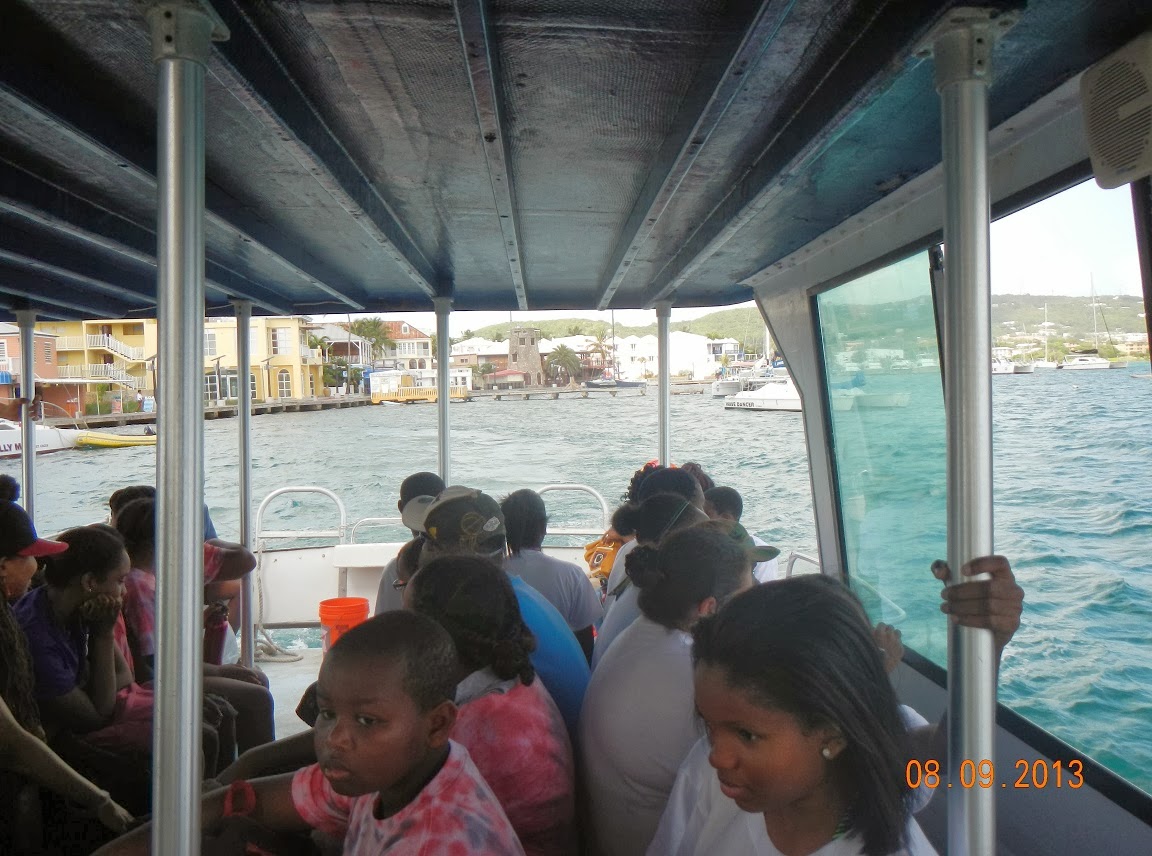
I promised my friends a long time ago that I would give them an update on how the big youth environmental conference and campout event went with the kids in our territory-wide Nature Explorers’ Club: Environmental Alliance. The event was titled “1st Annual Environmental Stewardship Youth Conference/Campout” and took place on August 9 & 10, 2013 at Cramer’s Park on the East End of St. Croix in the US Virgin Islands. Youths, instructors, and volunteers from five different alliance member organizations in both St. Croix and St. Thomas came together to acknowledge the environmental stewardship activities of the youths to the community and to vote on the public service announcements (PSAs) developed by the youths. Here are some photos along with captions of the event:
Sea turtle nest monitoring with The Nature Conservancy.
Our marine ecosystem.
Tent assembly "Where does this thingy go?"
We got one tent up! (as well as 3 others, but 1 fell down)
Lunch in our "Taino-style" tie-dyed shirts.
Volunteer and instructor. Our elders connecting with our youth.
On the boat to Buck Island.

The view from Buck Island.

You can't go to Buck Island and not swim.
Guest speaker at the conference and voting on the PSAs.


Friday, January 3, 2014

Magical Realism... What's That?

I’ve, essentially, always been a fantasy writer, but for a long time I used to say that I didn’t write fantasy. I would write about the reality I knew, and for most folks, that reality is fantasy. Admittedly, I’ve taken some forays into the more typical styles of escapist fantasy, but that old statement is still very much the cornerstone of my writing. I’ve also found it to be an adequate description for the Magical Realism sub-genre.


I’ve found that magical realism has become a literary term that for some has either faded into obscurity either by lack of use or overuse, and for others it’s just a head-scratcher. So, I’d like to provide some clarification, at least on my part, on what magical realism is.

  • Not Escapist: I think this is probably the most universal theme prevalent in all magical realism. It is not meant to take readers away to a land of world building and mystic creations. Everything in magical realism exists or has existed to some degree. While the backdrops may contain fantastic creatures and beings, they are typically as real to the writer as the reader’s household cat or dog. An escapist fantasy writer knows the dragon in his or story isn’t real. I know the chupacabra in my story is real. 
  •  Non-objective: Yes, I know it’s not the best or nicest term in the world but it does come close enough to conveying that magical realism is outside of what is typically considered normal or mainstream. It reveals cultures, traditions, and social themes that aren’t normally seen by the typical fantasy-reader.
  • Earthbound: I stress this in that the settings for magical realism are very much this world we live in. They may be slightly askew or require the inventing of a place that doesn’t exist, but even these fake places are just stand-ins for real ones. My invented metropolis of Glass City is really just a stand-in for a mix of Manhattan, Brooklyn, and Nantucket. 
  • Social Commentary: I found this one was truer for the more classical examples of magical realism, but I still think every approach to it, including modern ones that are brushing closer and closer to escapist fantasy, still do this. I agree that magical realism has to have a duty that takes precedence above the entertainment value of the piece (not to say that entertainment isn’t important as well). The story has to first reveal an important secret or truth about the society featured in the piece, and then it has to do this in an interesting and entertaining way, otherwise who would want to bother to read it. If all I wanted was the social commentary, I’d go to a guest lecture on the topic. 
  • Culture and Tradition: those elements that, for most of the readers, are fantasy elements are deeply rooted in the culture and traditions of the people in the story. In fact, I believe that culture has to be so omnipresent in the tale that not only is it like a character, but it becomes the main character. It’s not just another element in the development of the narrative, but the driving force behind every element of the piece. The magic system, the setting, the plot and character development, name selection, the underlying social themes, the “B” story between the girl and her mother, the humor and the melodrama… culture must be deeply embedded in all of these decisions and factors.

In the end, each of these factors are typically major goals I try to achieve in my writing endeavors. I even hope this blog article fits into this spectrum somehow. And while I know that when most readers finish one of my stories, they aren’t accepting the realism of the fantastic elements I included. That’s okay. I’m not asking them to take that leap with me, just to come along for the ride, hope they enjoy the sights, and that maybe they learn something and grow a tiny bit as people by the time they are finished.

Tuesday, December 24, 2013

Caribbean Christmas Pictures

It's the holidays, and I know that for most folks that means lots of snow and cold weather. I, therefore, thought it would be nice to share a touch of Caribbean warmth with some photos taken around my home of St. Croix in the US Virgin Islands. Credit for these images should be shared with my coworkers, Ms. Anne-Marie Gibbs and Mr. Halston Francis, since most of these images were taken while I was on the job and the camera would be shared between the three of us. Enjoy!


Friday, December 6, 2013

Glass City Query

Boy, it’s been a while. Sometimes the real world gets in the way, not to mention a lack of internet access at home. I’m back, though, and hopefully I can make my posts a bit more regular here.
I’m borrowing some sound advice from our good friend(s) over at Query Shark. To quote from her post #125 which is linked here: Query Shark #125
“Remember the formula: Who is the hero/heroine? What choice does s/he face? What are the consequences of that choice/not making the choice. That's what your first paragraph should cover.”

I’ve since had my own query looked over by a number of my friends at the online writing community of which we are members and they’ve helped me, along with the guidance from Query Shark, to get it pretty darn close to where I think it needs to be.

Here’s my current query letter (247 words). Any comments would be greatly appreciated.


Dear Mr. XXXX:

Glass City is an island metropolis off the eastern seaboard that hides a dark world beyond its guise of transparency. June is a photography major returning to her prodigal home to attend the university at the beckoning of her childhood boyfriend. She doesn’t know that he is a minion of the city’s vampire brood with plans to recruit her for her potential abilities. After her transformation, she hopes to confide in David, one of her nerdy floor mates, but he has his own problems to face when his soul is ripped from his body by a coven of warlocks to make him into a reanimated homunculus slave. The city’s werewolf pack is also on the move to increase its numbers, forcing June and her new vampire family to go on the offensive. The warlocks take advantage of the chaos run amok in the city and initiate their ultimate plan to revive their demon patriarch.
June is torn between saving her homunculus friend, befriending a new werewolf recruit, and forcing a renegade warlock to face up to her crimes, all while attempting to determine what her new identity should be. Is she a deadly vampire assassin, or can she still be June? This unlikely crew of mongrel creations must survive the chaos created by their respective clans if they expect to escape the darkness of this blood diamond of a city.
GLASS CITY is an urban fantasy novella complete at 40,000 words. I thank you for your consideration.

Nicholas Mena
[contact information]

Monday, April 22, 2013

Today I am appearing as a guest blog for a good friend of mine. I am disusing the role of social change in fantasy literature.

Fantasy for Social Change - Guest Post by Nicholas Mena